






20
2026

Ice Storage Bins in Split-Type Commercial Cube Ice Systems
Introduction: In a split-type cube ice machine, the storage bin is a working stage that carries ice from harvest to serving, so its design shapes daily ice quality.
People who assemble or specify a commercial cube ice system usually pour their attention into the freezing head — compressor, evaporator, harvest cycle — and treat the bin as a box that happens to arrive in the same shipment. In daily operation that order of thinking is backwards. The head runs in short batches, while the bin is where the ice spends most of its life before it reaches a glass. Reading the split-type layout, the drop path, cold holding, drainage, and the serving routine together makes it much easier to judge whether a given configuration suits a bar, a hotel pantry floor, or a small production site.
How a Split-Type Ice System Moves Ice from Freezing to Storage
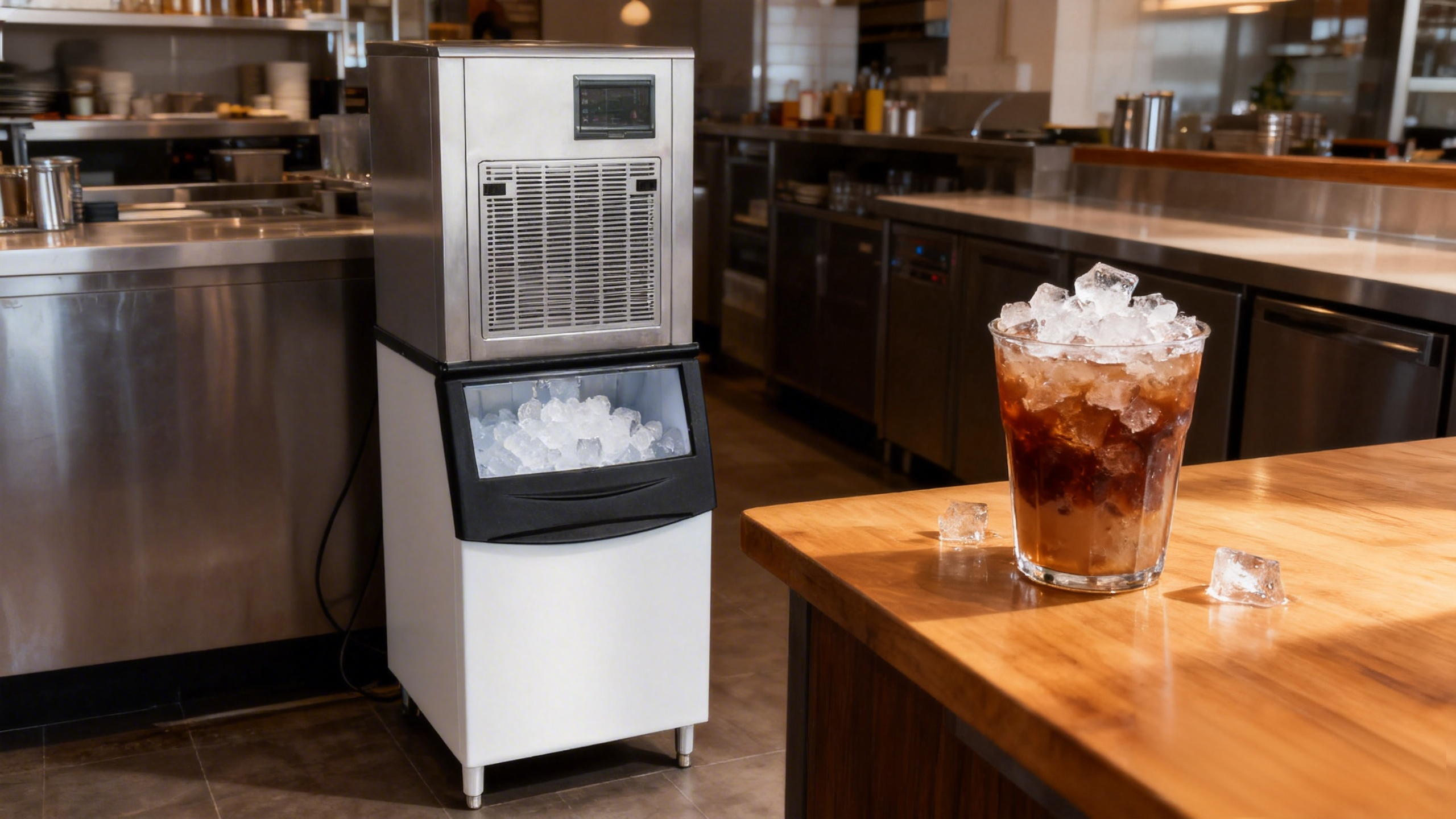
In a split-type layout, the ice-making head and the storage bin are two modules joined by an ice drop path rather than one sealed cabinet. Focusun’s cube ice product information describes this modular arrangement, with a separate head unit working above a bin — the shape most medium and larger cube machines take. Water enters the evaporator grid and freezes into cubes, the harvest cycle releases them, and gravity carries them down a chute or curtain into the bin below or beside the head. On many configurations the bin top doubles as the mounting platform, so the head sits over the opening and drops ice straight in. The reason this layout exists is service access and heat rejection as much as cabinet size. A split unit lets the condensing section sit where air or water cooling is practical, while the bin stays close to the point of use behind a bar or in a pantry corridor. When a buyer asks an ice machine supplier for a layout drawing, three details are worth tracing: how the head is supported, how far the ice falls, and whether the drop path is enclosed. A long open drop, a tight bend, or a chute running through a warm space collects meltwater and slows service. The head freezes, the bin receives and holds, the front connection hands ice to staff.
What an Ice Storage Bin Does Beyond Holding Ice
Cold holding is the obvious job, and it is more active than it sounds. Cubes stacked with no air movement fuse into one mass, and a bin that gains heat quickly sends meltwater down through the pile, softening every cube it touches. An insulated wall, a lid that closes fully, and a floor that slopes toward the drain keep that meltwater moving out instead of pooling around the ice. ASHRAE’s refrigeration references cover the underlying principle: the more stable the enclosed space, the less work the refrigeration loop does to hold it. Insulation earns its place here — it is the difference between a loose pile through a lunch rush and a bin that sweats. The second job is buffering. A cube machine harvests in batches, while a bar or banquet kitchen draws ice in bursts, and the bin absorbs the gap between those two rhythms. That is why usable capacity should be matched to the head’s daily output rather than picked on floor space alone. The third job is separation: the bin is the boundary between harvesting and serving. Ice that has fallen in is finished product, and everything after that point — lid, scoop, drain — is handling equipment. Bins in split layouts also carry structural duty, supporting the head on a reinforced top, so the frame and lid are part of the machine’s stability rather than a lid alone. Buyers comparing ice cube machine manufacturers tend to read the head unit’s capacity first. The bin deserves the same scrutiny, because it is where the two rhythms of production and use actually meet.
How Storage Hygiene Connects to Everyday Ice Use
Once ice lands in the bin it is treated as food. US FDA regulations for edible ice manufacturing in 21 CFR Part 129 set a sanitation frame for equipment and storage, and WHO drinking-water guidance covers the water that becomes ice in the first place. Together they explain why the storage stage gets the same attention as freezing. In practice, bin hygiene comes down to four things anyone can inspect by opening the door: surfaces, air exchange, tools, and drainage. A buyer who asks an ice cube machine supplier how those four are handled learns a lot about how carefully the system was put together.
1. Bin Surfaces and Airflow Affect Ice Quality Over Time
A cleanable liner matters because ice rests against the wall for hours, not seconds. Smooth stainless or food-grade plastic, rounded corners, and a floor that falls toward the drain let a wipe-down reach the surfaces instead of pushing residue into a corner. Air exchange is the other half of the story: every time the door opens, warm humid air enters, condenses on cold surfaces, and that moisture becomes a film on the ice. A lid that seats properly and a bin placed away from ovens, dishwashers, and warm exhaust reduce how often that cycle repeats. Dense, well-formed cubes tolerate it better than soft or wet ice, which links harvest quality to storage design.
2. Scoops, Doors, and Drainage Shape the Handling Routine
The scoop is the most-touched object in the system, and where it rests says a lot about how a site runs. A scoop left on top of the pile or on a nearby shelf picks up whatever is on that surface, while a dedicated holder inside or beside the bin keeps it clear of everything else. Gaskets and hinges decide whether the lid seals or hangs slightly open, and the drain decides whether meltwater leaves the bin or sits in the bottom. A drain line with a proper air gap and a steady fall away from the bin keeps wastewater from creeping back, and a dry floor cuts condensation around the base. Local food-safety rules set the actual cleaning and handling requirements for a given site, so align the routine with those.
Conclusion
The storage bin is the stage where cube ice stops being output and becomes stock. Drop path, insulated wall, sloped floor, tight lid, scoop holder, and drain all change how that ice behaves in a glass or a display case. When reading a system, work downward from the freezer: how the head is supported, how far ice falls, how the bin holds cold and clears meltwater, and how staff actually reach the ice. Focusun’s split-type cube configurations, with a separate head and bin, are one clear example of that modular approach to compare against other specification sheets.
FAQ
Q: What does an ice storage bin do in a split-type commercial ice system?
A: It receives harvested cubes from the head unit, holds them cold until service, and acts as the transfer point between production and serving. Along the way it manages meltwater, buffers the gap between batch harvests and burst demand, and often supports the head unit on its reinforced top.
Q: Why does insulation matter in a commercial ice storage bin?
A: Insulation slows heat gain through the walls, which keeps cubes from fusing into a block and reduces how much meltwater forms between servings. A better-insulated bin also keeps the enclosed space more stable, so the refrigeration loop spends less effort holding temperature and the ice stays loose and dry in the pile.
Q: How can ice stored in a bin lose quality during daily use?
A: Warm humid air entering through an open door condenses on cold surfaces and forms a film on the cubes, while standing meltwater softens the lower layers and speeds further melting. A scoop resting on the pile, a lid that does not seal, or a blocked drain all accelerate the same decline.
Sources / References
CFR – Code of Federal Regulations Title 21
Guidelines for drinking-water quality, 4th edition, incorporating the 1st addendum
Related Examples
Contacts & Support
Focusun Refrigeration CorporationRoom 603, Baohong Center
No. 7755 Zhongchun Rd
Shanghai CHINA
ZipCode: 201100
Tel: +86-21-5108 9946
Fax: +86-21-5227 2259
Email: enquiry@focusun.com
Sales: sales@focusun.com
Marketing: marketing@focusun.com
Press: press@focusun.com
Newsletter: newsletter@focusun.com
